Coordinate-agnostic matching of 3D buildings across independent city datasets
When disaster strikes, emergency teams must align newly captured UAV 3D building meshes with existing 3D city models - often without reliable GNSS or shared coordinates. This dashboard demonstrates an entity resolution pipeline that matches buildings purely by geometric shape, providing first responders with accurate situational awareness in damaged urban areas.
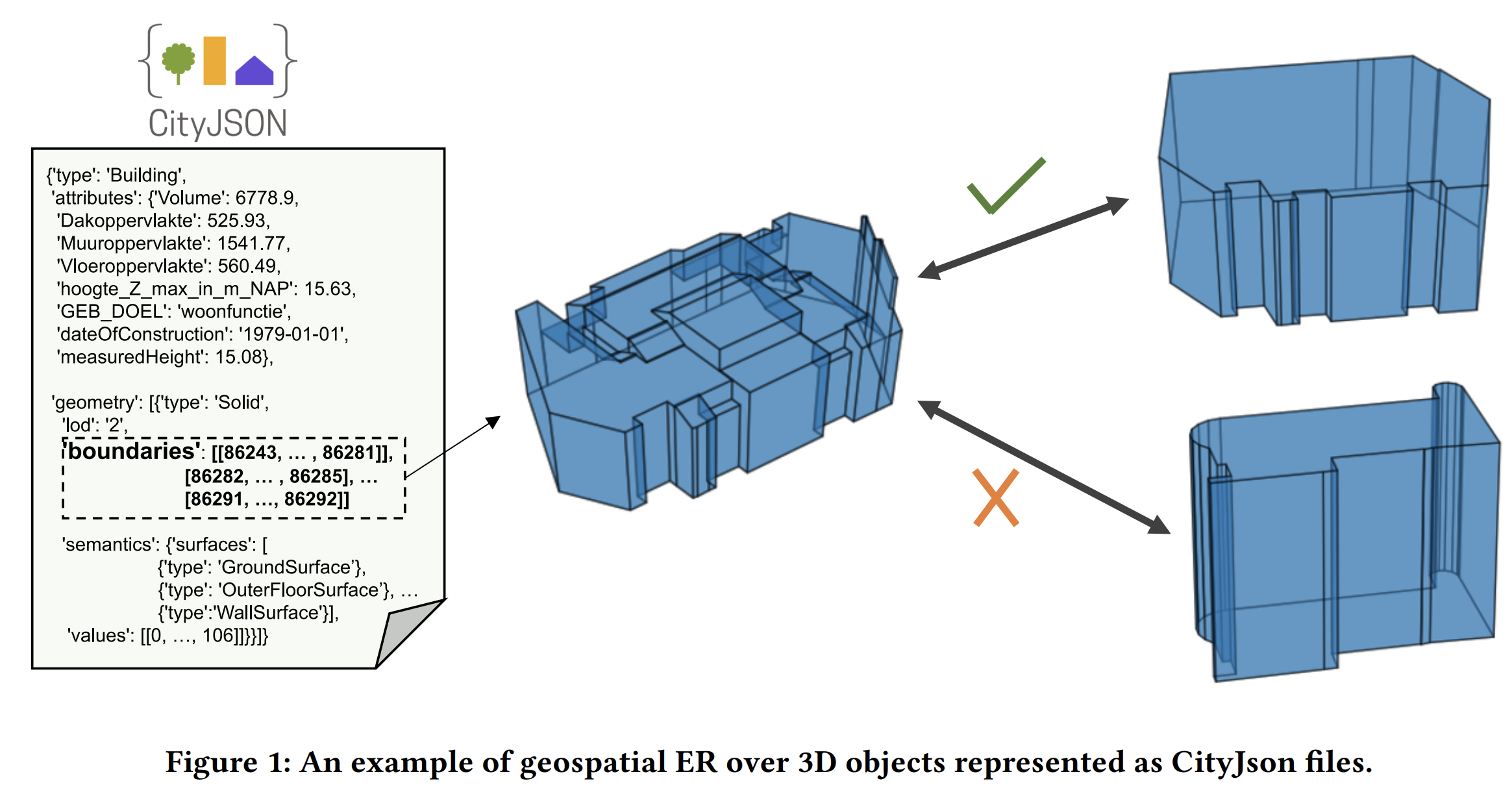
Two city surveys may model the same building independently, with no shared identifiers. The system determines which record in one dataset refers to the same real-world structure in another, relying solely on the geometry of the 3D models.
When datasets originate from different sources, they often use incompatible coordinate systems. Traditional matching methods fail in these cases because they compare coordinates directly. The pipeline matches buildings purely by their 3D shape, so coordinate misalignment is not an obstacle.
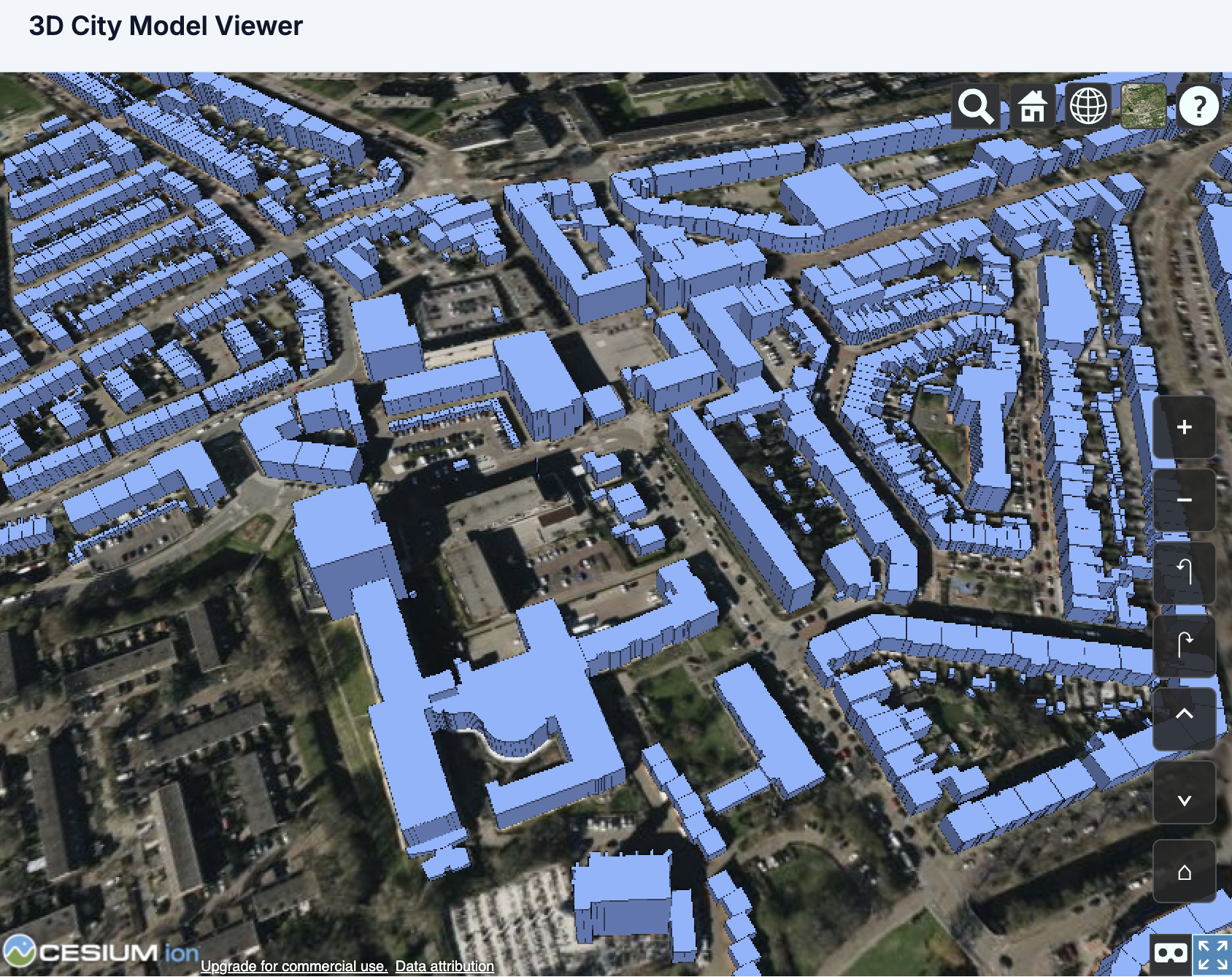
Buildings are stored as CityJSON files, a standard format for 3D city models. The pipeline processes the complete 3D surface geometry of each building rather than reducing it to a single point on a map, capturing shape details that a point representation would miss.
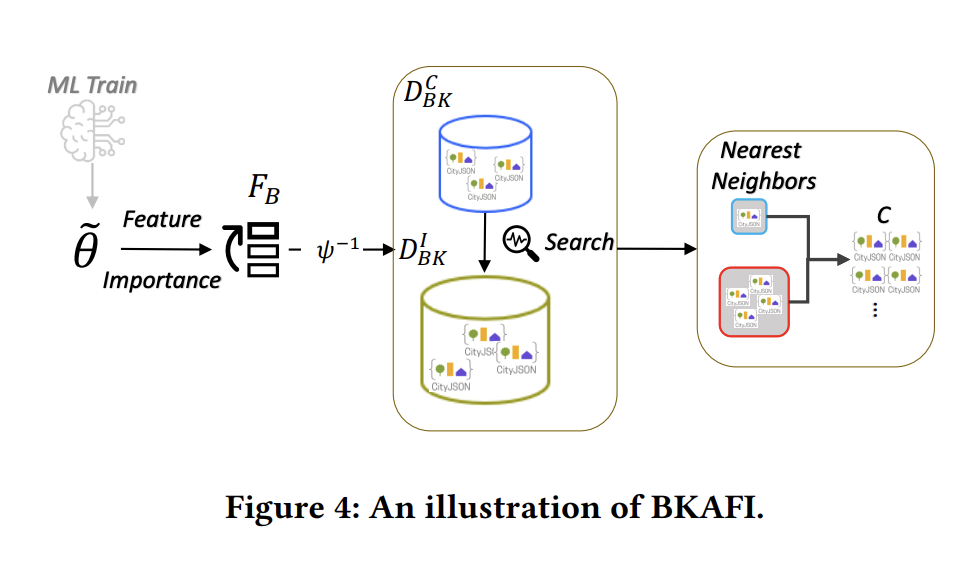
Comparing every building in one dataset against every building in another is not feasible at scale. The blocking step pre-selects a small set of geometrically similar candidates for each building, so the classifier processes only the most probable matches.
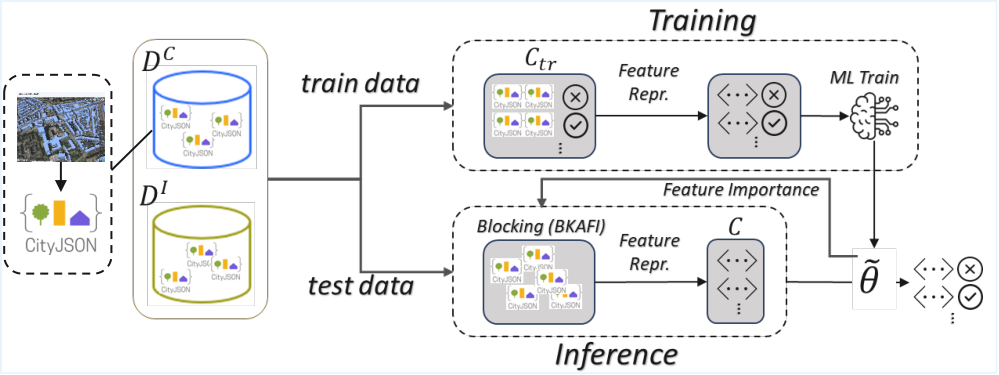
Each building is summarised as a set of geometric measurements: area, height, perimeter, compactness, vertex count, and others. These measurements form a compact numerical representation of the building's shape that a machine-learning model can process.
For each Candidate building, the blocking step selects a short list of the most geometrically similar buildings from the Index dataset. Only these candidate pairs proceed to the classifier, reducing the total number of comparisons from millions to a few per building.
A machine-learning classifier scores each candidate pair and outputs a confidence value. Pairs above the decision threshold are labelled as matches. The demo displays the results as a colour-coded map of the city, showing confirmed matches, false positives, and buildings with no match found.
For post-disaster UAV files without CRS metadata, Step 4 estimates a rigid 3D transform using anchor buildings and aligns the damaged candidate set to the index geometry. The output is written with the index dataset CRS so it can be rendered and compared in the correct coordinate reference system.
Run the full PDM pipeline on real 3D building data from The Hague. The tutorial guides you through the ER lifecycle, from raw data ingestion to visual verification of matches.
Launch Demo